
Every boxer who has ever laced up a pair of gloves has thought about it. That one punch that changes everything. Certain punches in boxing are more likely to cause a knockout during a fight. You may not be aware, but these punches may already be a part of your arsenal.
Identifying these punches and throwing them effectively can be game-changing. The boxing knockout punch is the decisive moment in a boxing match, and despite what casual boxing fans might think, it is almost never about just the raw power. It is the result of proper technique, timing, and effective punches that target vulnerable areas such as the chin and jaw, maximizing the chances of ending a fight when executed correctly.
In this guide, Sting Sports will share three of the most effective knockout punches in boxing, what makes each of these punches work, how to set them up, and how to train them correctly.
What Is a Boxing Knockout Punch?
A boxing knockout punch is any strike that leaves an opponent unable to continue the fight. Whether through unconsciousness or severe disorientation, a knockout ends the contest immediately and is one of the most dramatic finishes in boxing. Knockout punches have long been among the most exciting and memorable moments in the sport.
The Most Effective Knockout Punches In Boxing
Knockout Punch 1: The Cross
Why It Works
The cross is an effective boxing knockout punch that travels straight down the center, generates force from the entire body, and lands square on the chin, making it one of the most effective fight-ending strikes available to any boxer.
How to Throw It
Start from your guard with weight balanced. As you extend the rear hand, pivot the rear foot so the heel rises and the hip rotates fully toward the target. The shoulder follows the hip, and the fist arrives last, snapping at full extension. Return immediately to guard.
How to Set It Up
The jab is the cross's best partner. A sharp double jab disrupts the opponent's timing, draws attention to the front hand, and opens the straight line to the chin for the rear cross to follow. Every great cross in boxing history was set up before it was thrown.
Famous Fighters Who Made It Count
Lennox Lewis built his career on one of the most precise crosses in heavyweight history. Joe Louis was nicknamed the Brown Bomber largely because of his ability to land the rear cross with devastating timing and accuracy. Both fighters demonstrated that the cross does not need to be wild to be fight-ending. It needs to be placed.
Knockout Punch 2: The Left Hook
Why It Works
The left hook is another impactful boxing knockout punch that travels a short, compact distance from launch to target, transferring power generated from the base through the torso and into the fist. Its circular motion allows it to bypass an opponent's guard and land on the jaw, one of the most common knockout triggers in boxing.
How to Throw It
From your guard, rotate the lead shoulder inward and pivot the lead foot outward simultaneously. The elbow stays at roughly 90 degrees throughout the arc. Power comes entirely from hip and shoulder rotation, not from the arm swinging independently. The fist connects with the back two knuckles at the point of impact, not a slapping motion.
How to Set It Up
A cross thrown first draws the opponent's guard inward toward the centerline, opening the jaw for the hook to arrive from the side. A jab to the body is equally effective, forcing the guard down and exposing the head for the hook to follow immediately.
Famous Fighters Who Made It Count
Sugar Ray Robinson's left hook against Gene Fullmer in 1957 is regarded by boxing historians as one of the most technically perfect punches ever thrown. Fullmer was considered nearly impossible to knock out. Robinson landed one left hook, and Fullmer went down face-first.
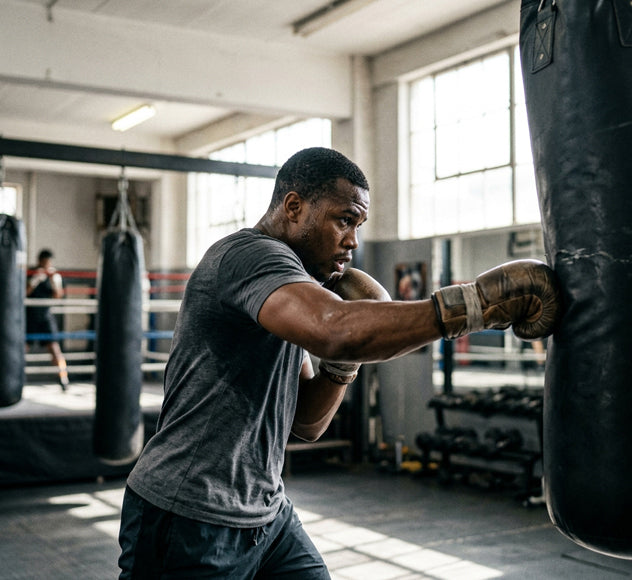
Using a quality punching bag to drill left hook repetitions develops both the mechanical accuracy and the hip rotation speed that makes this punch genuinely dangerous rather than just fast.
Knockout Punch 3: The Counterpunch
Why It Works
The counterpunch is a boxing knockout punch that times your shot as the opponent commits to their own punch, leaving themselves exposed. The momentum of your opponent moving toward you is used against them, multiplying the impact force dramatically and making it one of the most effective knockout punches in boxing.
How to Throw It
Slip or roll the incoming punch, then fire your counter in the same motion. The counterpunch can be a cross, hook, or uppercut depending on what the opponent gives you. The punch itself is secondary to the timing. Getting out of the line of fire and firing back in one fluid movement is the skill. Drilling counter exchanges at realistic intensity requires quality protective gear such as headgear, mouthguard, and body protector to practice safely without the injury risk that unprotected sparring creates.
How to Set It Up
Read your opponent's patterns before committing. The best counterpunchers are patient. They invite aggression, control distance, and wait for the moment their opponent commits to a punch that creates an opening.
Famous Fighters Who Made It Count
Juan Manuel Marquez's overhand right against Manny Pacquiao in 2012 produced one of the most dramatic moments in modern boxing history. Marquez feinted low to draw Pacquiao's guard down, then threw a perfectly timed overhand right as Pacquiao came forward. The precision of the setup made it one of the most calculated knockout punches ever recorded.
How to Generate Knockout Punching Power
Keep Your Feet Planted
In boxing, the middle position has your weight about 60% on the front leg and 40% on the back leg. It can also be 55/45. And the weight will shift subtly from foot to foot as you throw punches, although it’s most ideal to stay in your middle position.
Rotate Your Body
If you’re throwing a right cross, leave your front foot flat and pivot your back foot 45 degrees. As your back foot pivots, your hips will rotate slightly while your torso rotates a little more. Make sure your body weight drills your right leg into the ground.
If you’re throwing a left hook, your right heel will sit down flat on the ground while your left foot pivots. And as the front foot pivots, your hips and torso will also rotate slightly to the right.
Exhale and Squeeze
Right as you throw the punch, you make a tight exhalation sound right at the moment you punch. Some will even clarify that you make the exhalation sound right while your body and punching hand contract right when the punch lands to solidify your entire body into the shot.
How to Set Up Your Boxing Knockout Punch
Use the Jab as Your Primary Setup Tool
The jab is not a scoring punch in the context of knockout hunting. It is an information tool and a distraction mechanism. Every elite knockout artist uses the jab to measure distance, test reactions, and create the specific openings their power punches require.
A double jab followed by a cross exploits the natural flinch response. A jab to the body followed by a left hook exploits the guard dropping to protect the ribs. Learning to block punches in boxing is equally important in this context because understanding how opponents defend helps you identify which setups create genuine openings versus which ones only look like they do.
Control Distance and Angles
Wide punches always work well against guarded opponents because they are covering their vision somewhat and are less able to see punches coming from the sides. Mixing punches to the head and body, straight and curved, keeps an opponent guessing and creates the openings that knockout punches require.
Pivoting after combinations changes your angle relative to the opponent, forcing them to reset while you stay in position to throw the next power shot from an unexpected direction.
Sparring Is Where Setups Become Instinct
Technique on the bag is the foundation. The ability to set up and land knockout punches against a live opponent develops only through sparring. Controlled, structured boxing sparring rounds teach you to read reactions, time counters, and execute your setups under the pressure that bag work cannot replicate.
Training Your Knockout Power
Build the Foundation First
This guide is your roadmap to transforming from a fighter who pushes their punches into a knockout artist who pierces through targets. Technique at every skill level matters more than physical attributes. Developing a reliable boxing knockout punch requires patience, repetition, and sound mechanics.
Protect Your Hands in Every Session
Hand wraps are non-negotiable in any session where you are drilling power. They align the wrist, stabilize the knuckles, and protect the small bones of the hand from the cumulative damage that heavy bag and pad work creates over time. A hand injury that keeps you out of training for six weeks costs more than any single session is worth.
Work on Your Power Consistently
Practice a lot and start with hitting the heavy bag, mitts, and sparring partners. Having good technique is the fastest and easiest way to improve punching power more effectively.
Knockout Punches Quick Reference
|
Punch |
Primary Target |
Power Source |
Best Setup |
|
The Cross |
Chin, centerline |
Hip rotation, rear foot pivot |
Jab, double jab |
|
The Left Hook |
Jaw, temple |
Full body rotation, compact arc |
Cross, jab to body |
|
The Counterpunch |
Any target, timed on opponent movement |
Opponent's own momentum |
Slipping, feinting, patience |
Conclusion
The best boxing knockout punch is not the one thrown with maximum force. It is the one thrown precisely at the right moment and at the most vulnerable target. The cross, the left hook, and the counterpunch each represent a different path to the same destination. You may not get the chance to take that shot during the match, so you’ll have to rely on your skills developed through practice.
It takes a lot of practice and the right equipment to throw a perfect boxing knockout punch. Sting Sports is here throughout your journey, providing training gear that is built for fighters serious about developing real skills and improving their performance. Whether you are working on power, technique, or consistency, having reliable equipment can make every training session count.
FAQs
Q1. What is the best boxing knockout punch?
The left hook is the most effective boxing knockout punch. The left hook will land on the side of your opponent’s head, spinning it, which either knocks him out or makes him very dizzy. Another advantage of the left hook is that it comes from the side and so it’s hard to see. That's why the left hook is considered the most effective knockout punch.
Q2. What makes a punch a boxing knockout punch?
A knockout punch combines accurate targeting of the chin or jaw, correct technique using the full kinetic chain from legs through hips to fist, and timing that either catches the opponent off guard or uses their own movement against them.
Q3. How do I develop knockout power?
Knockout power comes from technique, not arm strength. Power starts from the ground: pivot your feet to drive the movement, rotate your hips to generate torque, and keep your core engaged to transfer that energy through your body and into your fist. This ground-up force is the key to developing real punching power
Q4. What gear do I need to train knockout punches safely?
To train knockout punches safely, you need boxing gloves, hand wraps, a punching bag, and headgear. Each of these pieces of equipment protects specific areas during practice on a heavy bag and sparring needed to develop real knockout power
Q5. How can beginners learn knockout punches safely?
Beginners should first focus on learning basic technique under proper supervision. With consistent training and practice, they will be able to develop power gradually and have less risk of serious injury.